
Coffee Knowledge
The History of the Vietnamese Phin Filter
How a French colonial relic became the heart of Vietnamese coffee culture
The Phin filter is so closely tied to Vietnamese coffee that it's almost impossible to picture one without the other. Yet it's not an ancient part of Vietnamese tradition at all, but a roughly 150-year-old import that Vietnamese coffee culture made so thoroughly its own that nobody thinks of it as foreign anymore.
A French invention on Vietnamese soil
Coffee arrived in Vietnam with French colonial rulers, who planted the first estates from the 1850s onward, initially mostly in the north and later mainly in the Central Highlands around Đắk Lắk. The brewing method came along with the coffee: a small metal filter placed on top of a cup that lets the coffee drip through slowly, similar to French filter coffee of that era. The name Phin is thought to derive from the French word filtre.
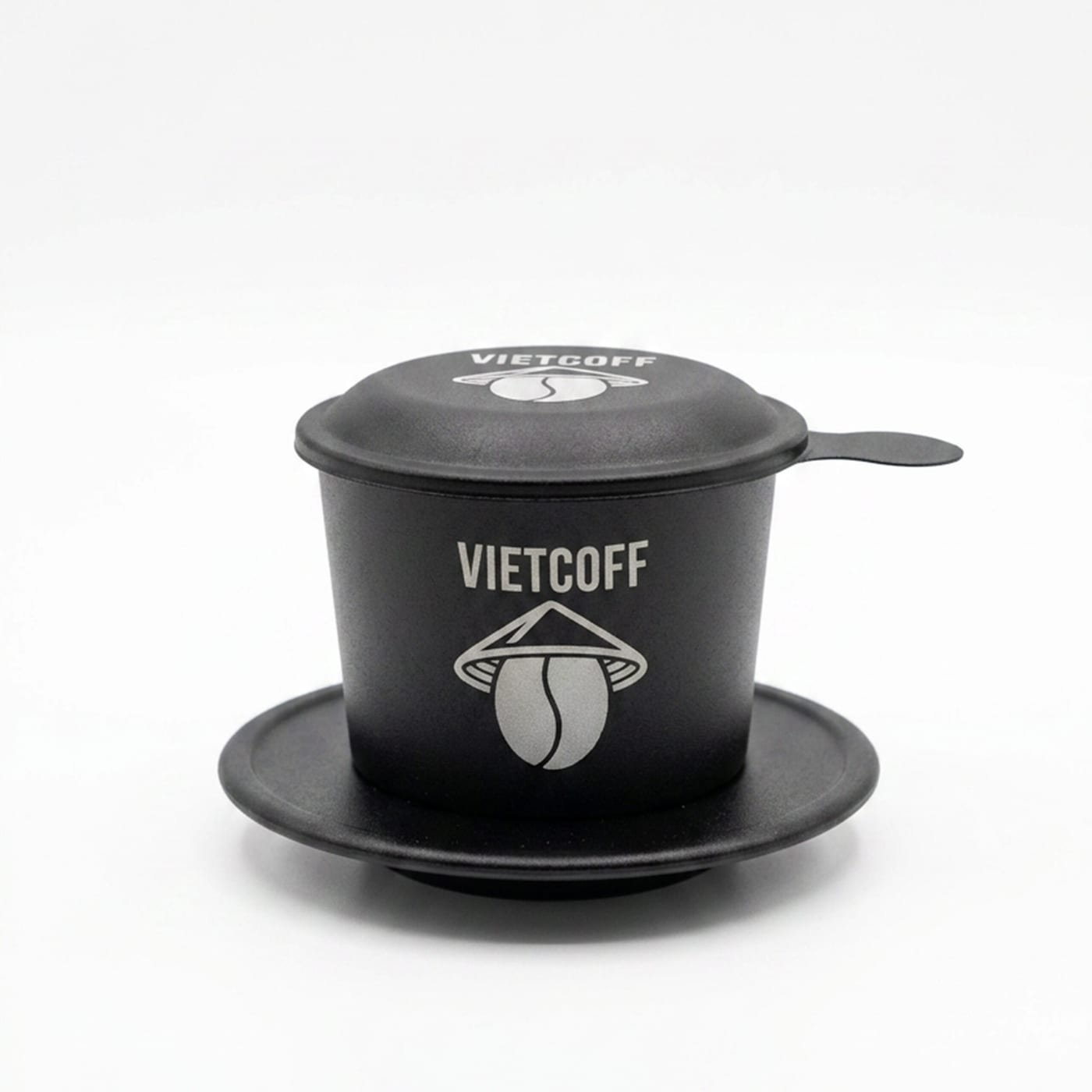
In Vietnam, that simple principle grew into its own brewing ritual: cup, perforated base, press plate and lid, originally mostly made of aluminium and today often stainless steel. The actual method itself has barely changed since those early days.
Why condensed milk instead of fresh milk
The classic combination of strong coffee and sweetened condensed milk, still found in Cà Phê Sữa Đá today, has a very practical origin. Fresh milk was hard to come by in early 20th-century tropical Vietnam: cold chains were missing, dairy farming was barely established, and imported fresh milk spoiled on the long journey.
Sweetened condensed milk, on the other hand, kept well, was affordable and easy to transport, and was widely available through French trade. What began as a workaround became a signature taste: the sweetness of the condensed milk balances the strong bitterness of Robusta coffee, the most common variety grown in Vietnam's highlands, and that exact combination is just as popular today.

The story behind VietCoff
Jona Hallbaur
Coffee was a fixed part of that everyday life. Back in Germany I missed it so much that I decided to bring it here myself. That's how VietCoff was born.
More about usA daily ritual, not a hipster trend
While pour-over and hand-filter methods are treated as a modern specialty-coffee movement elsewhere, the Phin filter has been part of everyday life in Vietnam for generations: on a plastic stool by the roadside, at the office between tasks, or as a quiet moment early in the morning. The slow drip, often four to five minutes, isn't a downside but part of the ritual, a moment to arrive before the day begins.
That combination of simplicity and consistency is probably why the Phin filter has changed so little internationally, even as entire coffee trends have come and gone around it.
The Phin filter today
Whether as the base for the purist Cà Phê Đen, the sweet and creamy Cà Phê Sữa Đá, or fancier variations like Hanoi's egg coffee Cà Phê Trứng, the Phin filter remains the common thread of Vietnamese coffee culture. It needs no electricity, no paper filters, and fits in any bag, just as practical today as on day one.
We recommend

If you want to brew with a Phin filter yourself, the step-by-step guide is in the basic recipe. The matching filter is available in the shop.